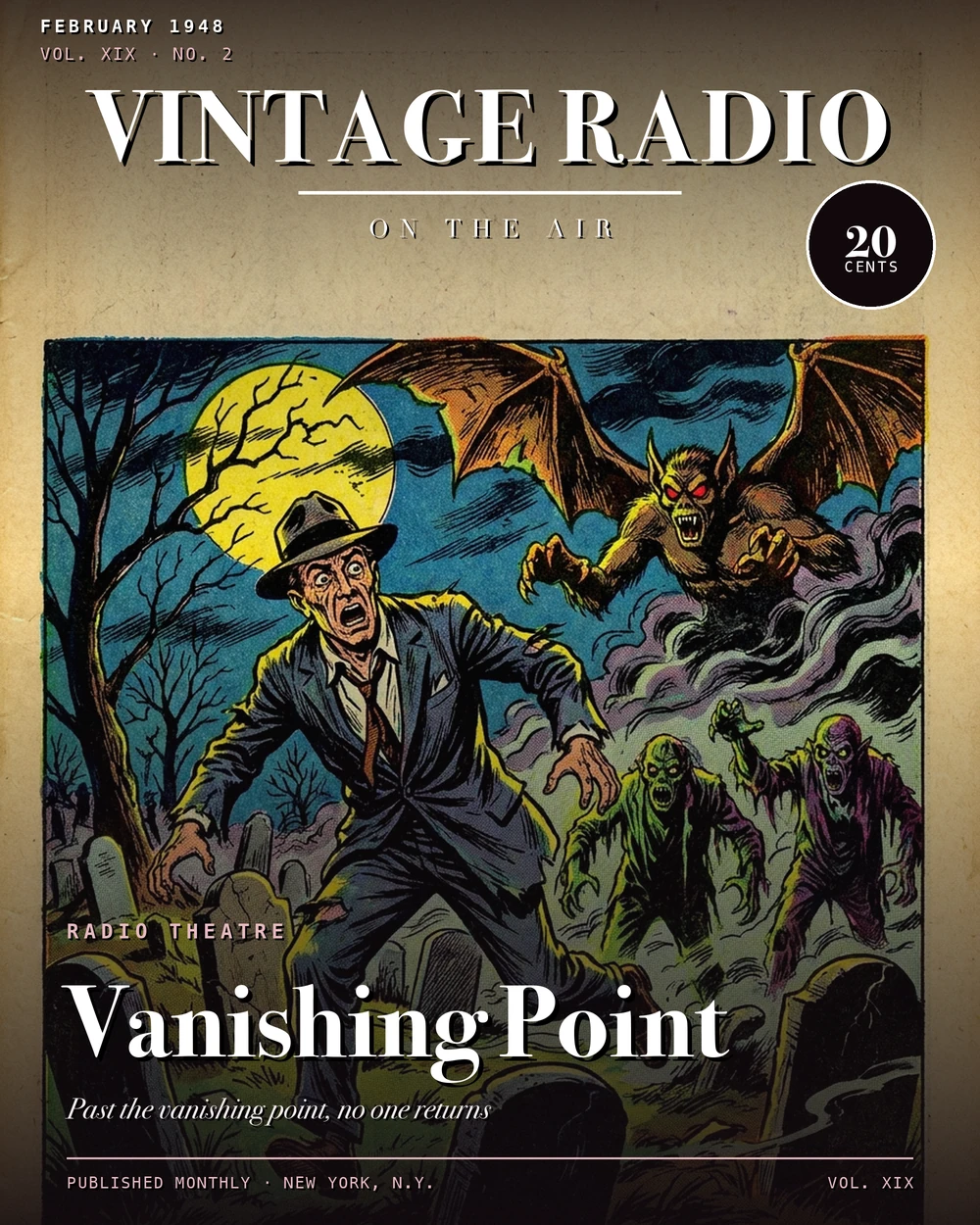
Vanishing Point
The Point Between Reality and Fantasy
Vanishing Point was CBC Radio's direct follow-up to its acclaimed horror anthology Nightfall, which had run from 1980 to 1983. Where Nightfall established that Canadian radio could do genuinely unsettling drama, Vanishing Point pushed further — billing itself on-air as "the point between reality and fantasy" and meaning it. The series mixed horror, science fiction, psychological drama, thriller, detective stories, comedy, and occasional musicals under one umbrella, making it harder to pin down than its predecessor and arguably more interesting for it. The original run's earliest known broadcast was September 30, 1985, and concluded June 23, 1986, though the series continued in later forms through January 1992.
The show was created and produced by Bill Lane, who had come to CBC Radio Drama in 1982 as a writer for Nightfall and worked his way up to Executive Producer of Saturday Stereo Theatre before launching Vanishing Point. Over his career at CBC Radio Drama, Lane directed more than 200 original plays and produced more than 500 — a scale that gives some sense of how seriously the corporation invested in audio drama during this period.
What Went Into Each Episode
Episodes ran approximately 30 minutes and were standalone anthology pieces — no serialized storylines, no recurring characters carrying over week to week. That format suited the range of material Lane was working with. Many episodes were original plays commissioned from Canadian writers, and Lane workshopped plays from winners of various Canadian literary competitions as a way of developing new playwrights and reaching new audiences. A significant portion were adaptations of short fiction by internationally recognized authors: Ray Bradbury, Roald Dahl, Arthur C. Clarke, John Wyndham, John Cheever, Daphne du Maurier, Jorge Luis Borges, and Evelyn Waugh all supplied source material at various points.
The production drew from CBC's coast-to-coast network of talent — writers, engineers, actors, and directors spread across the country. Recurring performers included Janet Wright and Stephen Ouimette, with guest players such as Paul Soles joining for select installments. Composer Tim Clark contributed original music to heighten atmospheric tension, and the production team made deliberate use of Foley artistry alongside carefully paced sound design to build atmosphere without any visual support.
Eight Episodes in the Catalog
The eight episodes here span the original 1985–1986 run and give a reasonable cross-section of what the series could do. "The Black Serpent," broadcast September 30, 1985, was written by Steve Petch and followed a woman vacationing on a Greek island who encounters a goddess — an early signal that the show's supernatural interests ran toward the mythic as much as the monstrous. "Curse of the Unnamed Planet," broadcast October 21, 1985, was an original script by Alfred Silver starring Saul Rubinek, about an alien scout disguised as a human child stranded on Earth.
"The Nine Billion Names of God," broadcast November 18, 1985, adapted Arthur C. Clarke's 1953 short story of the same name. "I'm a Stranger Here Myself," from February 17, 1986, was an original script by Nika Rylski about a new mother who becomes convinced she is actually an alien. "Looking for a Quiet Place," broadcast February 24, 1986, was written by Rachel Wyatt. The finale of the original run, "Open Wide," broadcast June 23, 1986, took an anxious man through a nightmare dentist visit and was recorded using Kunstkopf binaural sound — a technique that places microphones inside a dummy human head to capture audio in three dimensions, producing an unusually immersive stereo experience for listeners wearing headphones.
After the Original Run
The series didn't end with the June 1986 finale. After a summer hiatus, Vanishing Point returned in September 1986 with a six-episode adventure called The Black Persian, then shifted into a miniseries format with modernized adaptations of Nathaniel Hawthorne's work. Later phases brought serialized adaptations of science fiction by Arthur C. Clarke and Ursula K. Le Guin, with subseries sometimes running simultaneously on different days of the week. The show effectively became an umbrella program under which shorter miniseries could be developed, running in various forms until January 1992.
Vanishing Point belongs to the 1980s radio drama revival, not the classic golden age of American radio that ended in the early 1960s. It is a product of a public broadcaster investing in audio fiction at a moment when television had long since won the mass audience — which may be part of why it felt free to be strange.